Analysis & perspective
Why Private Equity Is Betting Trillions on Agentic Workflow Deployment
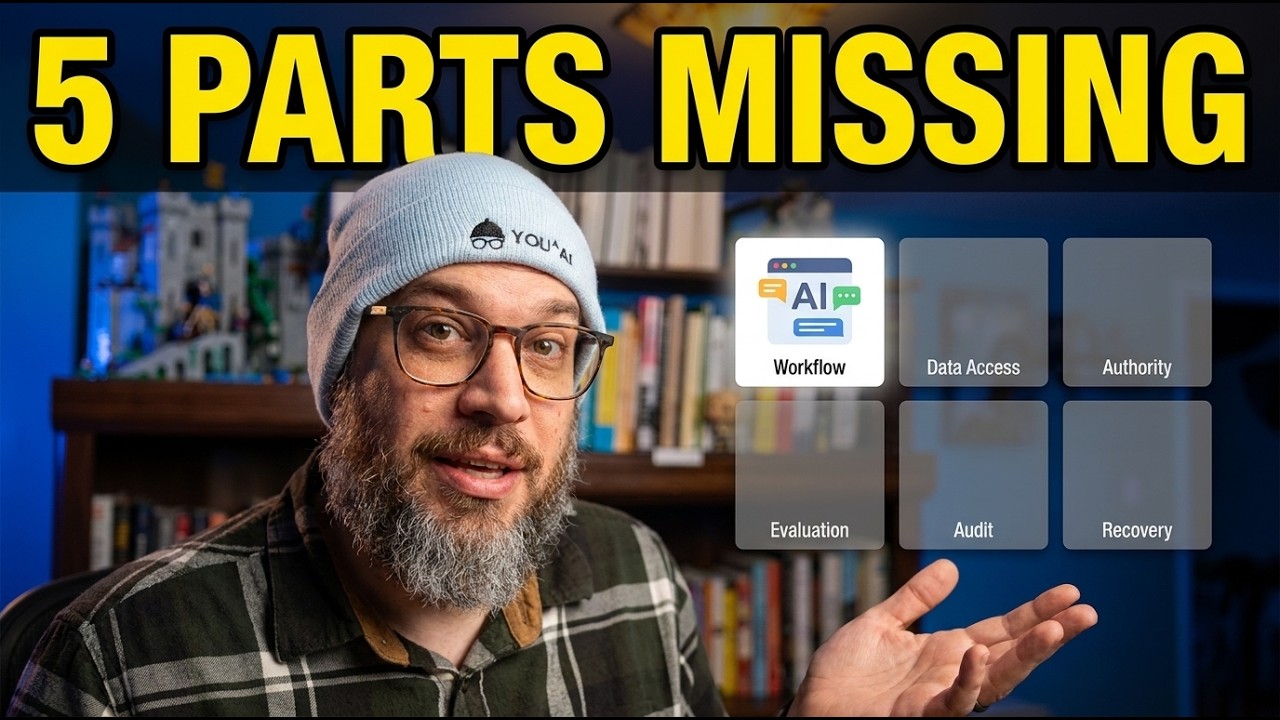
Nate B Jones breaks down why private equity, hyperscalers, and enterprise companies are all converging on agentic workflow deployment right now. Anthropic has backed a deployment arm with Blackstone, Hellman & Friedman, and Goldman Sachs at $1.5B; OpenAI's equivalent is valued near $10B. The thesis: reliable 100% workflow completion only became possible in spring 2026, and the disproportionate value in AI is in the implementation layer—the harness, evals, permissions, and audits—not the model itself.
"The Trillion Dollar Agentic Workflow Opportunity Is Here" by Nate B Jones — Watch on YouTube →
Key Takeaways
- Anthropic's deployment company is backed at $1.5B (Blackstone, Hellman & Friedman, Goldman Sachs); OpenAI's equivalent is valued near $10B—both are moving from model vendors to forward-deployed implementation partners.
- PE firms are funding this because SaaS multiples are collapsing and their existing portfolio companies need to pivot to agentic service models to retain value.
- Big consultancies (McKinsey, BCG, Accenture, PwC) are now inside the OpenAI Frontier Alliance program, building agentic delivery teams—not just doing change management.
- Systems of record (Salesforce, ServiceNow, Workday, SAP) are exposing agent APIs and acquiring data companies—they're not ceding their position to startups.
- The moat is in the completed workflow (harness, evals, permissions, audits, post-launch ownership)—not the model. OpenAI's own Frontier alliances post confirmed the bottleneck is implementation, not the model quality.
What you can actually set up from this
Extracted from the video's own transcript — the specifics the original summary left out.
Reproducible steps
- Workflow design
Decide which decisions the model makes, which steps stay human, where the handoffs are, and what counts as done. Every step needs an owner, an input and an output.
- Data access
List the sources of truth the agent reads, the row- and field-level permissions that apply, and which records are authoritative versus stale.
- Authority
What the agent may do, against which systems, with what spending or commitment limits. Reading, writing and spending are three different risk profiles.
- Evals
Score the agent's adherence to your specific business rules before output goes anywhere. A public benchmark is not an eval.
- Audit trail
Decide what must be logged so an auditor can reconstruct what happened after a failure.
- Recovery and ownership
Define how a wrong action is reversed, and who on the customer side keeps the system tuned after launch.
Gotchas
- When evaluating an agent vendor, ask them to show each of these six layers. Generic answers ('the model will keep improving', 'your data is the key') suggest the vendor hasn't built them.
- This is market analysis; the six-part checklist is the reusable part.
More ChatGPT news
 The same coding agent in CrewAI, the OpenAI Agents SDK and LangGraph — and when to pick each
 GPT-6 Sol and Luna: where each one lives, what it costs, and which tier to point an agent at
 A map of the 5-hour Codex course: 18 core concepts, an AI operating system, skills, and a 15-task Codex vs Claude Code bake-off
 Jev live: gating a destructive delete at 96% "no", and scoring a sales lead at 97% confidence
 Six steps to Codex skills that hold up: reverse-engineer, one trigger, verify, walk the model down
 ChatGPT Work's data agent: build a data-context skill from Databricks, Slack and Drive