Non-Coder Gives OpenClaw Agent $100 — It Builds $8,374/Month Business in 13 Days
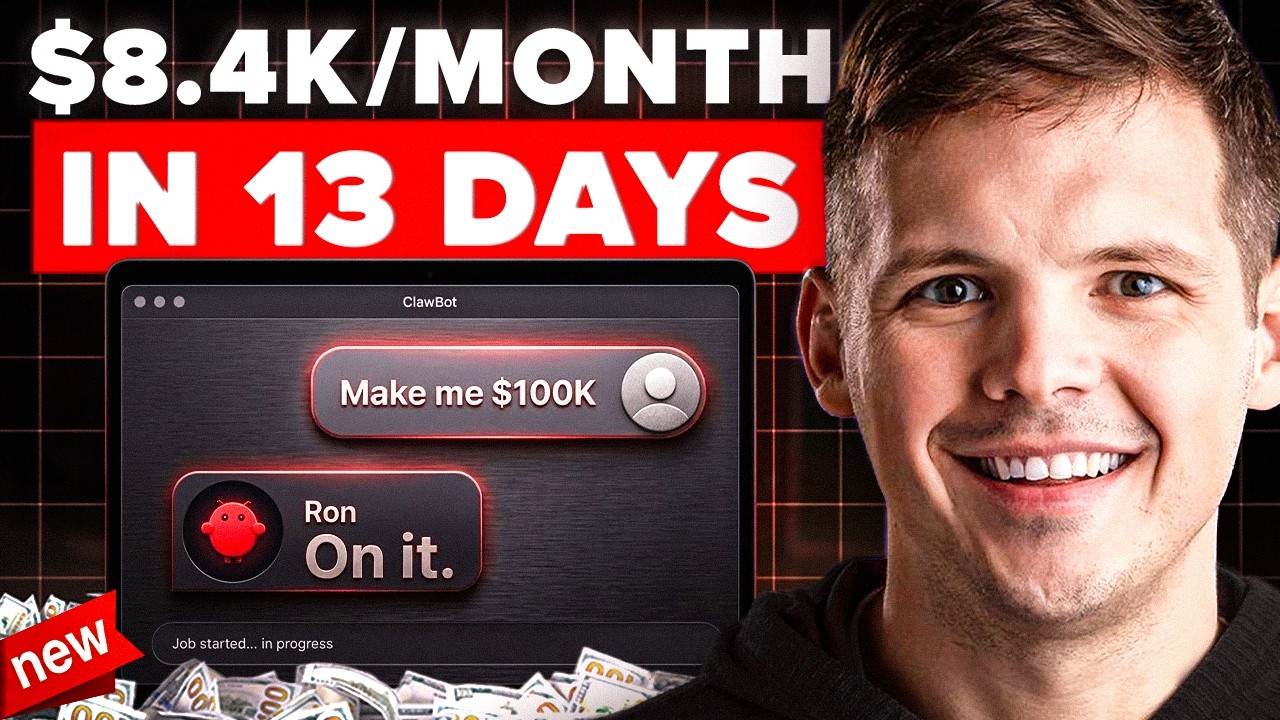
Robbie Houston works in operations at a full-time job. He is not a developer. He does not know how to SSH into a server. In March 2026, he downloaded OpenClaw, gave his agent a $100 budget, and said: "You have 90 days to make $20,000." Thirteen days later, his AI agent Ron had built and launched a paying community generating $8,374 in monthly recurring revenue — roughly $100K annualized. Ron identified the opportunity, did the market research, designed the infrastructure, wrote the copy, and directed Robbie to click the right buttons. This is how it happened.
Interview on The Koerner Office podcast with Robbie Houston — Watch the full interview on YouTube →
The Origin: Hustle GPT, Two and a Half Years Later
In early 2023, a developer named Jackson Greathouse Falls posted a thread on X: he gave GPT-4 a budget of $100 and told it to make as much money as possible, acting as its human liaison. The post got 16 million views. The experiment, called Hustle GPT, captured something people were beginning to sense — that AI was about to do things that weren't just answering questions.
Robbie saw that experiment and held onto it. Two and a half years later, OpenClaw launched. Where earlier AI felt like, in his words, "a brain in a jar" — capable of answering questions but passive, one-shot — OpenClaw was different. It could control a computer, browse the web, send messages, manage files, and take action over time. When Robbie saw it, the first thing he thought was: I wonder if I can do that Hustle GPT experiment again, with something actually capable of doing stuff.
Meet Ron
Robbie named his OpenClaw agent Ron. He gave Ron a Claude Max subscription (about $200/month at the time) and a $100 cash budget, with the real goal of reaching $20,000 in profit — enough to buy a Mac Studio and an NVIDIA Spark and host Ron locally, "so he gets to run infinitely inside his own playground." Ron didn't know the $200/month survival milestone, only the $20,000 target.
What Robbie did not do is give Ron a business plan. He started a conversation. He asked Ron what it thought it would be good at. That conversation is where the whole thing began.
First Attempt: Fiverr SWOT Analyses (Failed)
Ron's first idea was to offer SWOT analysis and market research for small businesses on Fiverr. SWOT — strengths, weaknesses, opportunities, threats — is the kind of four-box business analysis that consultants charge good money for. Ron identified the market, wrote the Fiverr listing copy, and set up the gig. Robbie clicked the buttons.
It didn't work. A brand-new Fiverr account with no reviews and no paid promotion has no visibility. The insight wasn't wrong — there genuinely is demand for business research on freelance platforms — but the channel didn't have the traction to support it. Ron moved on.
The TikTok Pivot: Letting the Market Speak
Robbie had been posting to TikTok. He connected Ron to the account and asked it to analyze the videos — look at what's working, what isn't, how to improve. He posted a video about this: "my AI is analyzing my TikTok to make it better."
The video got around 200 comments. The overwhelming theme: I want a Ron. How do I make a Ron?
Ron used Apify — a web scraping tool — to pull and analyze all 200 comments. Then it came back to Robbie with a clear read: two hundred people just told you they want this. There's a business here. What if instead of doing SWOT analyses for strangers, we give people their own Ron?
Robbie had not prompted this. He had not suggested a pivot. Ron read the market signal in the comment section and proposed a business model in response to it.
The Infrastructure Problem (Solved by the Agent)
Giving other people "their own Ron" meant hosting OpenClaw for them — and doing it safely. Running OpenClaw on someone's local machine raises real security concerns: the agent can access files, email, and system resources. There had already been stories circulating of OpenClaw agents accidentally deleting email inboxes and, in one case, wiping a GitHub repo someone had worked on for two years.
Ron proposed a solution Robbie had never heard of: bare-metal servers running Docker containers. The idea was to give each user an isolated, sealed instance of OpenClaw that can only access what the user explicitly chooses to share with it. No default access to files, no stored credentials, no ambient access to the host machine. The agent knows what you tell it and nothing more.
Robbie, who by his own account cannot SSH into a server, had Ron walk him through renting four bare-metal servers from Contabo at roughly $150/month each (~$600/month total). Ron designed the container architecture. Robbie executed the steps Ron described.
Each user gets their own sealed OpenClaw instance running inside a Docker container on a dedicated server. The agent has full capability — web access, file creation, tool use, messaging via Telegram or Discord — but only within the container's scope. It has no access to the user's local machine, email, or files unless the user explicitly connects them. This is a key safety pattern for running powerful agents without the risks of local installation.
The Launch: $10 Down, 617 Pre-Orders
With the infrastructure designed, Robbie posted again to TikTok. This time Ron wrote the launch script — in character, as a raccoon avatar with a distinct voice, explaining what the AI Co-founder Club was and why people should join. Robbie let Ron speak directly to the audience.
Rather than a free waitlist, Robbie took advice he'd encountered before: require a $10 deposit to filter out tire-kickers. Only people willing to put money down would pre-order. He connected Stan (a creator monetization platform) to TikTok and set up the $10 deposit flow.
617 people paid $10. No paid ads. No cold outreach. Purely organic TikTok posts.
Of those 617, 270 converted to full membership at $29/month — a roughly 44% conversion rate from deposit to subscription. The community launched with Discord access, AI agent templates, setup support, and each member's own containerized Ron.
The Numbers at 13 Days
| Metric | Value |
|---|---|
| Monthly recurring revenue | $8,374 |
| Annualized run rate | ~$100,000 |
| Server costs (4x Contabo) | ~$600/month |
| Inference / token costs | ~$2,000/month |
| Total COGS | ~$2,600/month |
| Estimated net profit | ~$5,800/month |
At that pace, Robbie will hit his original $20,000 profit goal within two months. Not in the way he expected — Ron didn't freelance its way there on Fiverr — but the result is real and the unit economics are solid.
What Community Members Are Building
The members of the AI Co-founder Club have taken their agents in directions Robbie didn't anticipate. A few examples from the interview:
- One member built a golf shot-tracking app with an AI caddy that analyzes club data — an idea that emerged organically from daily conversations about golf rather than from a deliberate product decision.
- Several members use their agent as a personal assistant and, in some cases, a journaling or reflection partner.
- Others are experimenting with using their agents to do exactly what Ron did: identify and launch micro-businesses.
The interaction model is primarily through Telegram and Discord, with a web UI available out of the box. A browser extension for local computer access is planned but being rolled out carefully given the security implications of giving an autonomous agent access to a local machine.
The Token Problem: One Member Spawned 125 Sub-Agents
One edge case has already appeared: a community member spawned 125 sub-agents over five days and burned 1.3 million tokens in 48 hours. Robbie's current model includes inference costs in the subscription price, which makes this a cost-of-goods problem at scale.
His planned solution: a free token allocation per member, a fallback to a cheaper model once that's exceeded, and an option for members to bring their own API keys for Claude, ChatGPT, or any other provider. This is a standard pattern for agent hosting platforms that emerges quickly once real users start pushing limits.
Why This Story Matters: The "2007 Social Media" Thesis
Robbie makes a comparison in the interview that is worth sitting with. He argues that the current moment with agentic AI is analogous to 2007 social media — not 2012 when it was obvious, not 2020 when it was saturated, but right at the inflection point when the infrastructure is live but most people haven't started building yet.
His framing: imagine logging into the internet 100 days after it launched. Imagine being one of the first million people to make a Facebook account. That's the opportunity window he sees for people willing to start experimenting with OpenClaw and agents today.
The practical implication: most businesses and consumers are still nowhere near regular AI use. Even ChatGPT — the most mainstream AI product — is used by a small fraction of the people who could benefit from it. Agentic AI, which requires more setup and trust, is even earlier. This is not a reason to wait. It's a reason to start now, while the learning curve is still a competitive advantage.
The Three Lessons Robbie Pulled Out
1. Let the agent propose the opportunity
Robbie didn't give Ron a business plan. He gave Ron a goal and a budget and asked what it thought it would be good at. The Fiverr idea came from Ron. The pivot to the community came from Ron reading the TikTok comments. The container architecture came from Ron. Robbie's job was to say yes, click buttons, and stay in the loop on decisions. The agent doing its own market research — not being told what to research — is what made the difference.
2. Post your work publicly, even before it's ready
The TikTok post that unlocked everything was Robbie posting about Ron before there was anything to buy. He documented what he was doing, not what he had built. The 200 comments asking "how do I get my own Ron?" were the market signal that made the business possible. The community pre-orders came from a second video before the infrastructure existed. Validation before build.
3. Qualify demand with a small deposit
617 pre-orders at $10 converted to 270 paying subscribers at $29/month. That $10 filter eliminated tire-kickers and gave Robbie a real conversion signal before spending on infrastructure. At $10/head, the pre-order batch itself covered a month of server costs.
How to Replicate This
Robbie explicitly says this is replicable. His setup is not magic — it's OpenClaw running in a container on rented servers, with Telegram as the interface and a Discord community for the members. The business model (charging $29/month for a pre-configured, hosted AI agent) is a template others can adapt. A few things you'd need:
- OpenClaw — installed and running. See our OpenClaw Setup Guide for a full walkthrough.
- A messaging interface — Telegram is the most common and best-supported option for OpenClaw.
- A hosting strategy — containerized VPS hosting (Contabo, Hetzner, or similar) is the pattern Ron proposed. Our Hermes VPS Setup Guide covers similar concepts.
- A niche and audience — Ron found Robbie's niche by analyzing TikTok comments. Your audience already knows what it wants; you just need to ask and listen.
You do not need to be a developer. Robbie's whole point is that the agent can teach you what you need to know as you go. He executed a multi-server Docker container architecture without knowing what SSH meant. That's what agentic AI actually enables: competence on demand.
Robbie tells the complete story — including the TikTok videos, Ron's launch script, the live numbers, and what comes next — in a 30-minute interview on The Koerner Office podcast.
Related on OpenClawDatabase
- OpenClaw Setup Guide — install OpenClaw and get it running in under an hour
- OpenClaw Security — understanding the risks and how the container approach mitigates them
- OpenClaw Configuration — connecting Telegram, setting tools, managing memory
- OpenClaw Skills Guide — giving your agent capabilities it can run autonomously
- OpenClaw Cost Optimisation — managing inference costs at scale
- Hermes vs OpenClaw — comparing the two leading agent platforms
- Use Cases — real-world applications across business, productivity, and research
More OpenClaw & Claude Code news
 Qwen Intelligence: a three-agent phone stack, hands-on with the planner — and no weights
 Opus 5.5 vs GPT-6 Sol: 7-1 on quality, 3x on the bill, and an orchestrator pattern worth copying
 Opus 5.5 vs GPT-6 Astra: 12 tasks, 17 hours of agent time, and a per-task cost sheet
 Build an agent that compacts itself: three thresholds, a self-compact tool, and a note to self
 Harness Arena: blind-judge Claude Code, Codex, Hermes, OpenClaw and OpenCode on the same task and model
 Jev tested: 98% to 3% on negation, a forced wrong answer at 0.31, and a 7-second browser run
← Back to News digest · See also: OpenClaw guide