Give Hermes Permanent Memory with a Free Obsidian Vault
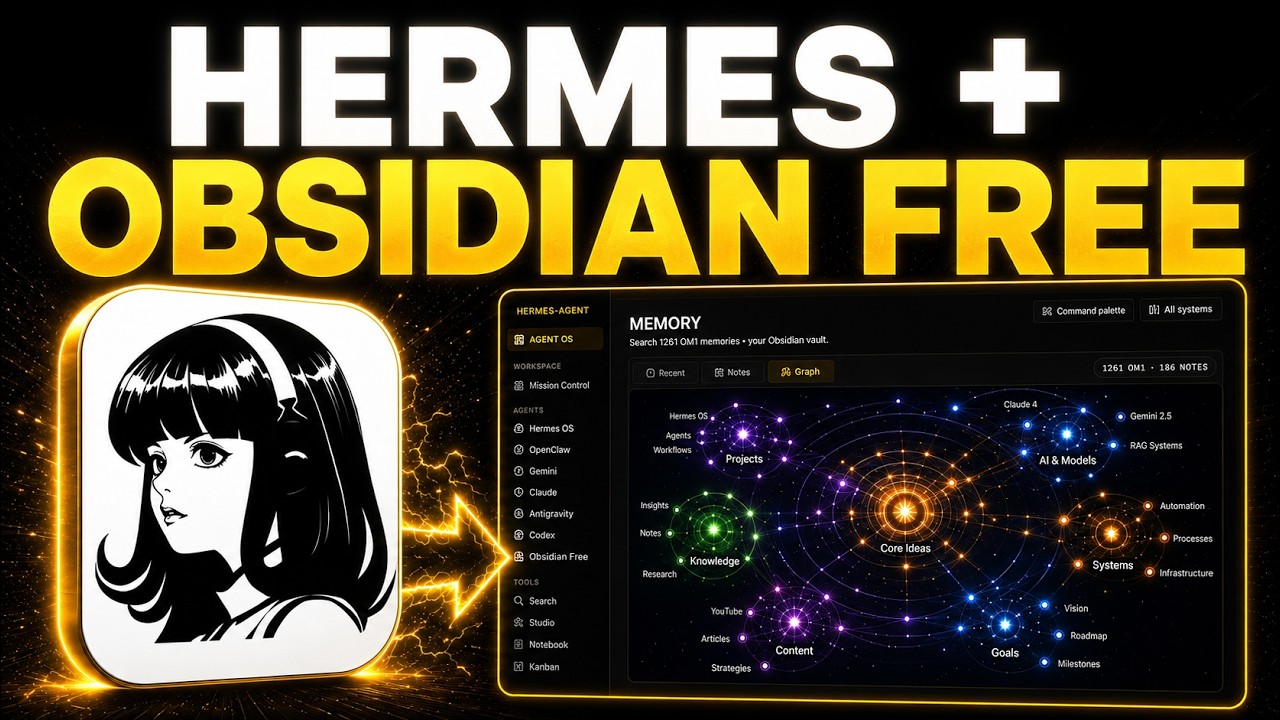
Without a persistent memory layer, Hermes starts from scratch on every session — it doesn't know your goals, your past work, or your context. Wiring it to an Obsidian vault solves this completely. The vault is just a folder of markdown files, which means Hermes, Claude, and OpenClaw can all read from the same source of truth. Hermes also writes new notes back automatically, so the memory grows without any manual effort.
"Hermes Obsidian is Insane (FREE!)" by Julian Goldie SEO — Watch on YouTube →
Key Takeaways
- Point Hermes at a local Obsidian vault once — every subsequent task starts with full context: your goals, clients, past work, and brand voice.
- The vault is plain markdown files, so Hermes, Claude, and OpenClaw can all read the same folder. All agents speak with a consistent, personalized voice.
- Hermes writes new notes back to the vault after each session automatically, so context accumulates without you having to maintain it manually.
- Responses become grounded in your actual situation rather than generic, reducing the need to re-explain context on every conversation.
- Messy vaults aren't a problem — you can ask Hermes to organize, tag, and clean up your notes as a one-time task.
- Both Hermes and Obsidian are free and open source; this is a zero-cost upgrade to your agent setup.
Why This Matters: The Context Re-Paste Problem
Every AI agent — Hermes, Claude, ChatGPT — starts each session knowing nothing about you. The standard workaround is to paste a context block at the start of every conversation: who you are, what you're working on, what your goals are. This is tedious, error-prone, and means you're always one forgotten paste away from generic output.
The Obsidian vault approach solves this at the architecture level. Instead of pasting context, you have a local folder that your agents read on every run. The first time is setup; every subsequent session is instant. And because Hermes can update the vault itself, your context document gets richer over time automatically — it notes what you built last week, what you decided, what you want to try next.
Sharing One Brain Across Multiple Agents
The most powerful aspect of this setup is that the vault isn't tied to Hermes specifically — it's a shared memory layer for your entire agent stack. If Hermes completes a task on Monday and Claude answers a question on Tuesday, they both read from the same vault. They reach the same conclusions about your context, use the same voice, and reference the same history. This eliminates the fragmentation that comes from each agent living in its own silo with no awareness of what the others have done.
Related on OpenClawDatabase
- Hermes Memory Architecture — how persistent memory works in depth
- Hermes Agent Hub — overview, setup, and all guides
- OpenClaw SOUL.md — the equivalent persistent context layer for OpenClaw
- Compare agent platforms — Hermes vs OpenClaw vs Claude Cowork
More Hermes news
 Running a Hermes agent in a real business: permissioning, skills and the trust ladder
 Hermes /loop: recurring agent wake-ups with real stop conditions
 Grok Bot setup: give each bot its own email instead of sharing your accounts
 DeepSeek V4 Pro 0813 driving Hermes agent: agentic benchmarks jump, cost stays low
 Nemotron 3.5 Lightning on vLLM: the Mamba flags for a local agent execution model
 Prime Agent vs Hermes: Self-Writing Notebook vs Shared Vault