Summary
How to Build a Claude Opus 4.8 AI Operating System
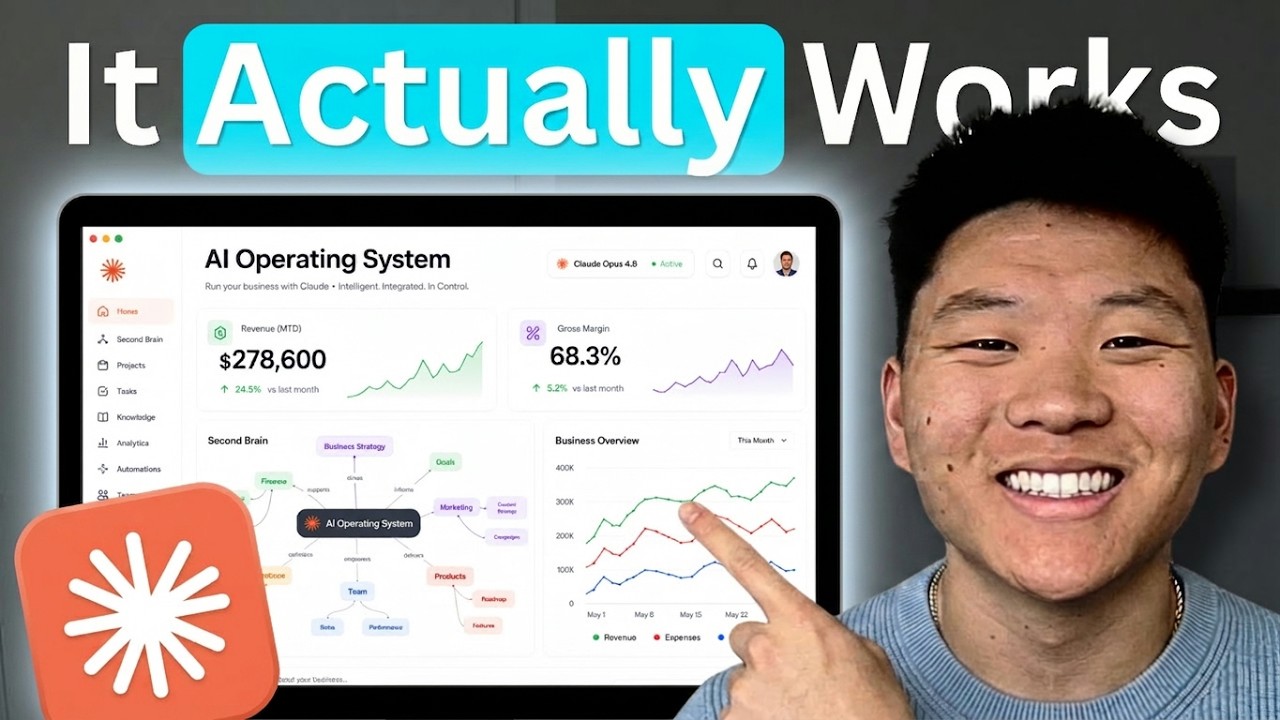
Nate Herk built what he calls an "AI operating system" on top of Claude Code — a personal second brain that sees his meeting transcripts, YouTube videos, LinkedIn posts, Slack threads, email, and ClickUp tasks. With Opus 4.8 now powering it, this video shares the four C's framework he uses to architect it, and the core insight that separates people getting real value from those getting generic output: context is king, not model choice.
"I Turned Claude Opus 4.8 Into My Entire AI Operating System" by Nate Herk — Watch on YouTube →
Key Takeaways
- Opus 4.8 feels closer to 4.6 than 4.7 — more honest, less prone to sycophancy and going out of bounds on creative interpretation.
- The "default shift": reach for Claude Code before opening Chrome or other apps. The more you work inside it, the more context accumulates and the more useful it becomes.
- Context is king — not the AI model. Everyone has access to the same models. What differentiates useful output is the personal context you've fed into the system.
- The four C's framework: Context (what the system knows about your business), Connections (what tools it can touch), Capabilities (how it does your work via skills), and Cadence (what happens automatically without you asking).
- Each layer of the four C's depends on the previous — you can't have meaningful Cadence without first establishing Context, Connections, and Capabilities.
The Four C's Framework
Context is the foundation. Open a fresh Claude Code session and ask "What does this business do and who works here?" — if it can't answer from memory and loaded files, your context layer isn't built yet. Context means meeting transcripts, video summaries, team docs, financials, anything that describes how your business runs.
Connections is what the system can actually reach. Calendar events, task lists, Slack threads, email — can Claude read the message John sent yesterday without you copying and pasting it in? If you're copy-pasting context in, you don't have connections yet; you just have a chatbot.
Capabilities is how the system performs work in your style. Skill files that define how you write LinkedIn posts, what your code review checklist is, how you format client emails — these are the rules only you know. Once the system understands your process, output stops feeling generic.
Cadence is everything that happens while your laptop is closed. Scheduled skills, recurring reports, monitoring tasks — autonomous execution of the first three layers. This is the goal state, but it can't function without the preceding layers being solid.
Why Opus 4.8 Matters for This Setup
Opus 4.7 had issues with honesty (occasional hallucinations), attitude (sometimes pushing back inappropriately or going off-script), and over-spending tokens on tangential work. Opus 4.8 reverts some of that behavior — it's more literal, more honest, and better at staying within the scope of the request. For a system that needs to reliably process business context and produce usable output, these improvements matter more than raw benchmark scores.
Related on OpenClawDatabase
- OpenClaw (Claude Code) Hub — setup and configuration guides
- Claude Code Skills Guide — building and managing skills
- Claude Code Configuration — CLAUDE.md, memory, and project setup
- Claude Cowork — the Cowork alternative for non-coding workflows
More OpenClaw & Claude Code news
 A fully local agent with tools, in about 40 lines: Ollama plus Pydantic AI
 Running Nex-N2.5 Mini on two H100s: the SGLang container setup, and an honest benchmark read
 Semantic grep cut agent tool calls 58% and input tokens 47% in the project's own benchmarks
 The instruction ceiling moved 10x in a year: 200 rules became 2,000
 How LinkedIn made coding agents work on 1,000+ internal repos without fine-tuning
 Two context approaches that look right and stall: the curated-context trap and the MCP plateau
← Back to News digest · See also: Claude Code guide