Analysis & perspective
OpenAI Codex Micro: A Six-Key Pad Built to Run Agent Fleets
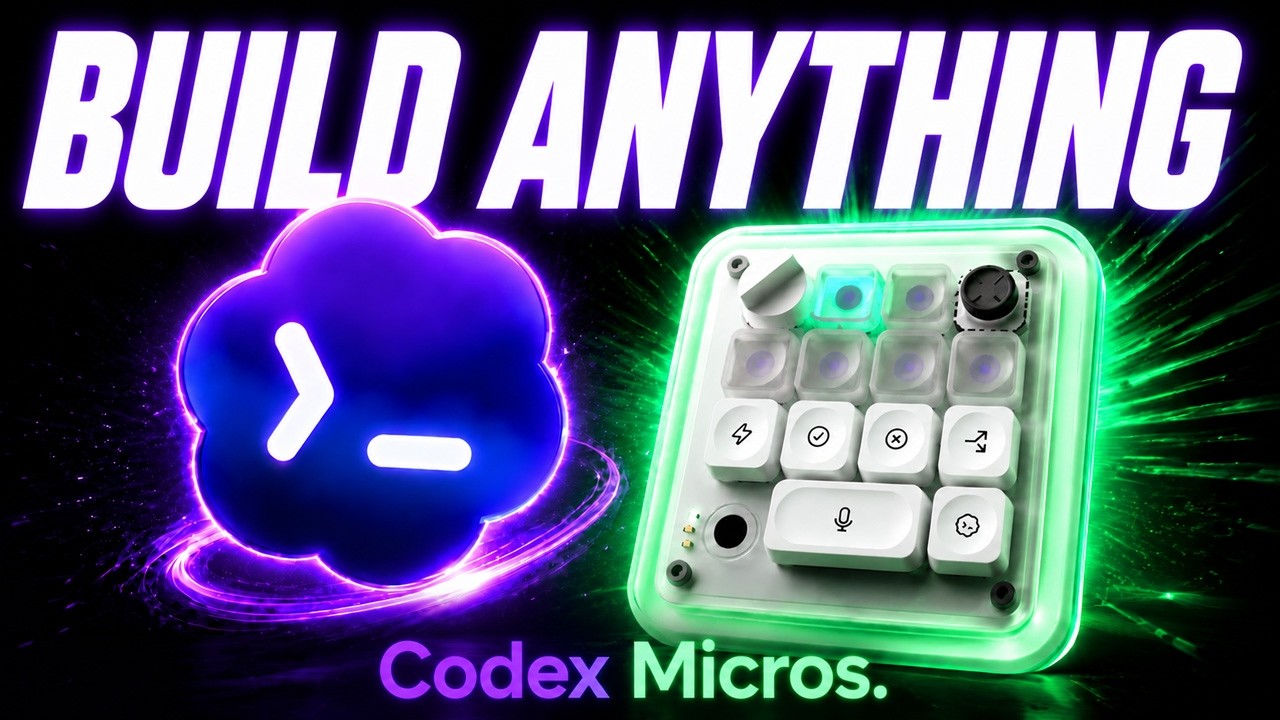
OpenAI's first piece of hardware is not a speaker — it's a small macro pad called Codex Micro, built in collaboration with keyboard maker Work Louder. Six backlit keys each map to a running Codex agent and glow with its live status, a dial adjusts how much reasoning effort an agent spends, and a joystick fires common workflows like review, debug, or cleanup. The video frames it less as a must-buy accessory than as a signal of how OpenAI expects people to work: supervising several agents at once rather than typing one prompt at a time.
"NEW Codex Micro Is INSANE!" by Julian Goldie SEO — Watch on YouTube →
Key Takeaways
- Six keys, six agents. Each key binds to one Codex agent and lights by state — white for idle, blue for thinking, green for finished, red for needs attention. One tap selects that agent; a double tap brings its session to the front.
- The dial sets reasoning effort. Turning it one way requests a fast draft; the other way lets the agent spend more compute on a harder task — replacing a trip into a settings menu.
- The joystick launches preset workflows such as reviewing work, hunting a bug, or cleaning something up, in one flick rather than several clicks.
- It's a rebadge, not a ground-up build. Work Louder already made the programmable macro pad; OpenAI supplied branding and a set of default key mappings.
- Not everyone is convinced. The video quotes a tech writer who answered "no" to whether you need one, calling it a fun toy whose productivity benefit is still unclear — a fair critique of adding physical buttons to a tool built around plain-language typing.
- Scale context: Codex was cited at roughly 5 million weekly users as of last month, approaching 9 million total — so even modest adoption of the pad touches a large group.
- A bigger device is reportedly coming. Separate reports point to a screenless AI companion device expected to be announced by year end, launching sometime in 2027.
No hardware is required to run several agents in parallel — the pattern matters more than the peripheral. If you want the same multi-agent supervision habit without buying anything, see our platform comparison and the ChatGPT agent mode guide. Note this video also promotes a paid community; the product facts above are reported independently of that.
More ChatGPT news
 OpenAI's Agents API is a hosted Codex harness — here is what it takes over
 Sketch-to-layout in ChatGPT Image 2.5, and a real test of edit consistency
 Codex Desktop for Business: Setup, Approval Modes and Scheduled Tasks
 Docker's Agent Sandbox Runtime: Scoped Credentials Per Task, Local to Cloud
 Codex browser and computer use: saving flows as skills you can schedule
 Same prompt, three harnesses: a Claude vs Grok vs Codex writing test (hands-on comparison, not a how-to)