Summary
Sonnet 5.5 vs Opus 5.5 on seven real tasks: when the cheaper model wins
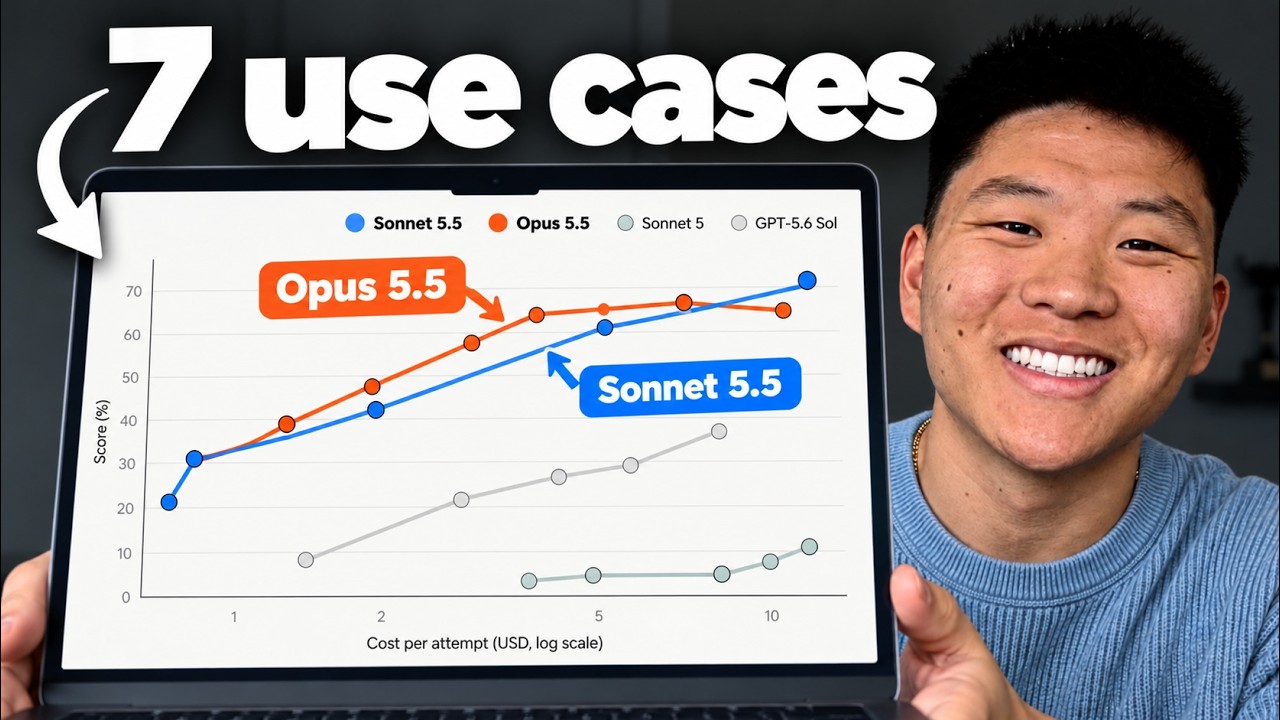
Nate Herk runs both models at high effort on seven real workflows and scores each. Sonnet won four and Opus three; Opus won where the prompt was open-ended, Sonnet where the spec was clear. Opus cost about double per task, and he re-prompts Sonnet instead of upgrading.
"I Tested Sonnet 5.5 vs Opus 5.5. What You Need to Know." by Nate Herk — Watch on YouTube →
What is checkable
- Prices: Anthropic lists Claude Sonnet 5.5 at $2 input / $10 output per million tokens and Opus 5.5 at $4 / $20, so Opus is about double. Both have a 1M-token context window and 128K max output; Sonnet 5.5's default effort is
highand Opus 5.5's ismedium. Source: Claude Sonnet 5.5 overview. - Anthropic's own guidance, as the video reads it: Sonnet for well-scoped everyday coding, bug fixes, high-volume development and polished documents, slides and spreadsheets; Opus for complex work needing careful judgment, long-horizon agentic coding, and the hardest problems.
- Before you swap Sonnet 5 for 5.5 in code: Anthropic lists breaking changes (forced
tool_choicereturns a 400, thinking blocks are tied to the account that produced them, and more). See the migration guide.
To turn off up-front thinking on Sonnet 5.5, Anthropic says to send this at high effort or below, instead of "disabled":
model: "claude-sonnet-5-5"
thinking: {"type": "between_tools"}
The test, as he ran it
Both models were run on the same prompt at high effort, with cost shown in API dollars rather than subscription usage so the comparison is repeatable. His scoring was subjective, and he says so.
- Landing page for a drink brand: Sonnet won the hero; Opus used the real product image and was better elsewhere. Sonnet ran 28 minutes against 52 and cost about half as much. Verdict: Sonnet, because one re-prompt would fix the fake can.
- Motion showreel: Opus, clearly better taste and copy; Sonnet about $14 against about $20.50 on Opus.
- Vague "90-day growth plan": Opus, with a clearer quarter-aligned plan and a task-level write-up; about $9 against a little under $5 for Sonnet.
- Investor deck plus Excel model from mock data: near-identical outputs, both with live formulas; Opus was actually cheaper and faster here.
- Local-model explainer using his HTML explainer skill: Opus explained better, Sonnet looked better at half the price; he scored it for Sonnet.
- X news dashboard: Opus looked better, about $6 more and 7 minutes longer; scored for Sonnet on cost.
- YouTube resource guide using a skill: near-identical; Sonnet twice as fast and about $1.40 cheaper.
Across all seven sessions Opus ran about 46 minutes longer, used about 38 million more input tokens (fewer output tokens) and cost about $16 more.
The rule he takes away
- Clear spec and a way to check the result → start with Sonnet 5.5. A skill that defines what good looks like lets Sonnet match Opus.
- Open-ended, subjective work where you want a thought partner → Opus 5.5.
- Run each skill with both models once, note which does better, and keep that choice per skill. If Sonnet's first output is close, re-prompt it rather than paying for Opus.
- He says to test on your own skills and processes; his tasks are one person's workflows.
Claims in the video about Sonnet 5.5 being "30% faster and 30% cheaper for most work" are his; Anthropic's listed price is the same as Sonnet 5, so any saving comes from token use, not the rate.
More OpenClaw & Claude Code news
 Hyperframes Studio: draw on a frame, let your coding agent fix the video, and what it needs to run
 Google's Android skills for coding agents: the install commands, writing your own SKILL.md, and which new claims we could not confirm
 GitHub Copilot CLI agents: build one with /agent, share it through a plugin marketplace, then run it headless in CI
 Designing a CLI for agents, not humans: JSON in and out, one pattern, a skill that ships with it, and Airbyte's MCP lessons
 Anthropic cut 80% of Claude Code's system prompt: how to audit your own skills and CLAUDE.md with /doctor
 Why Reducto deleted its one-tool-per-endpoint MCP server and rebuilt it with fewer, workflow-shaped tools