Published: 2026-10-21
Summary

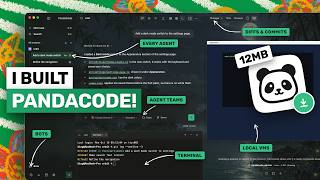 Panda Code: a free desktop app that runs Claude Code, Codex and other agents side by side, with worktrees, agent teams and queue vs steer
 How Monzo built its Slack coding agent: an MCP gateway, sandboxed remote agents, an egress proxy and a swappable model
 Free Claude Code, an independent proxy: route Claude Code to Ollama or OpenRouter free models, with fallback and per-tier overrides
 Evals for a Claude Agent SDK agent with Phoenix: trace it, pick the right judge, check the judge, prove the fix, run it in CI
 A personal knowledge base for your agent without vector databases: incremental connectors, cheap-model summaries and "atoms", BM25 search, recency weighting
 The Roast Room: a Claude Code skill where seven persona subagents debate your decision in three rounds
Summary
A durable news agent: cron ticks, a Pi Durable agent behind an API, Jev as a cheap gate, and taste weights you tune by chatting
Chapters / key moments (click to jump — plays here on the page)
A proactive agent, in IndyDevDan's words, is a durable agent plus a trigger inside a sandbox. His example is a news agent that wakes on a cron tick, uses a cheap classifier to filter before spending model tokens, and lets him correct it by thumbs-up, thumbs-down and plain-language instructions. The code is in a link he gives, which we have not reviewed; the design is described clearly enough to follow.
Source video
"My Jev Pi Durable Agent CURATES News: HYPE, FACT, or SIGNAL" by IndyDevDan — Watch on YouTube → He also promotes a paid course launching at the end of November; that is not part of the project.
The architecture
- Client-server split. The real agent runs on his Mac mini (and separately in an exe.dev cloud sandbox). The browser UI, the terminal UI, the CLI and the cron job are all thin clients of one API, so the browser and the terminal show the same session.
- Layers. SQLite databases, then Pi Durable (the durable-task layer built on the Pi agent), then a custom durable agent exposed over an API, with Jev for classification, and an SDK used by every client. Models named: a GPT-6 Luna agent; he says cheap models such as Luna, Haiku 5.5 and DeepSeek V4.1 Flash keep cost down.
- Trigger. Cron fires every minute. Each tick looks for a maximum of seven cards.
The pipeline: gather, gate, dedupe, rank
- Jev is the gate. Jev (from TypeSafe) is a cheap, fast classifier placed in front of the language model so expensive calls only happen on items that pass. Uses: is this relevant, is it a duplicate story (after a content hash), and is this claim a fact. A final pass scores the item as hype, fact or signal.
- His definitions. Hype is attention driven by excitement; fact is objectively true; signal is a fact you can act on. In the demo, a Gemini 4 Argon release item scored mostly signal and fact, with 66 out of 100 for hype.
- Agent tools. Run a news sweep, list candidates, read items, search the web, scrape a URL, research items, classify with Jev, present news, present a timeline, and ask about taste. The agent has no file or code tools; the tools are specific to the job.
Feedback that changes the ranking
- Thumbs-up or thumbs-down on a card feeds back into ranking.
- You can message the agent while it sweeps; the message queues. He typed "increase the weight of Gemini, and add it as a keyword if it isn't one". The agent read its taste files and raised the existing Gemini keyword weight from 1.2 to 1.3.
- The settings page lists weighted keywords and weighted source links (for example Hacker News, Latent Space, the Pi project, Claude Code, Anthropic, Codex, OpenAI and Simon Willison), all editable.
Gotchas & Caveats
- We did not read the linked code, so tool names and weights are as shown on screen. He says he is not sharing his own settings.
- A job that runs every minute with a model call costs real money; the gate is there for that reason, and he says costs have barely moved.
- "In the loop, near the loop, out of the loop" is his framing for how much human attention a system needs. It is a mental model, not a measured result.
Key Takeaways
- Put a cheap classifier ahead of the model, and dedupe by hash before asking a model if two items match.
- Give a proactive agent a small set of job-specific tools rather than general file access.
- Store preferences as editable weights so you can correct the agent in a sentence.
More OpenClaw & Claude Code news
Panda Code: a free desktop app that runs Claude Code, Codex and other agents side by side, with worktrees, agent teams and queue vs steer
How Monzo built its Slack coding agent: an MCP gateway, sandboxed remote agents, an egress proxy and a swappable model
Free Claude Code, an independent proxy: route Claude Code to Ollama or OpenRouter free models, with fallback and per-tier overrides
Evals for a Claude Agent SDK agent with Phoenix: trace it, pick the right judge, check the judge, prove the fix, run it in CI
A personal knowledge base for your agent without vector databases: incremental connectors, cheap-model summaries and "atoms", BM25 search, recency weighting
The Roast Room: a Claude Code skill where seven persona subagents debate your decision in three rounds