Published: 2026-10-21
Summary

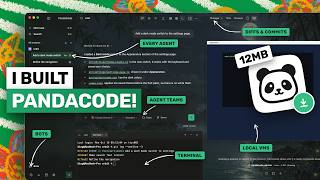 Panda Code: a free desktop app that runs Claude Code, Codex and other agents side by side, with worktrees, agent teams and queue vs steer
 How Monzo built its Slack coding agent: an MCP gateway, sandboxed remote agents, an egress proxy and a swappable model
 A durable news agent: cron ticks, a Pi Durable agent behind an API, Jev as a cheap gate, and taste weights you tune by chatting
 Evals for a Claude Agent SDK agent with Phoenix: trace it, pick the right judge, check the judge, prove the fix, run it in CI
 A personal knowledge base for your agent without vector databases: incremental connectors, cheap-model summaries and "atoms", BM25 search, recency weighting
 The Roast Room: a Claude Code skill where seven persona subagents debate your decision in three rounds
Summary
Free Claude Code, an independent proxy: route Claude Code to Ollama or OpenRouter free models, with fallback and per-tier overrides
Chapters / key moments (click to jump — plays here on the page)
FCC is an independent open-source project, not affiliated with Anthropic, that listens on your machine and forwards Claude Code's requests to a model you choose, including local Ollama models and free OpenRouter models. Fahd Mirza installs it, sets a default model plus a fallback, and stops Ollama mid-task to see whether work continues. It is a useful pattern, and Anthropic's documentation is clear that this route is unsupported.
Source video
"Free Claude Code: Can You Really Run AI Coding Agents for Free?" by Fahd Mirza — Watch on YouTube →
What the video shows
- Install. A one-line installer from the project's repository (linked in his description). It asks whether to also set up Codex and which providers to configure; he declines the extras. Then he starts the proxy server and leaves that terminal open; a dashboard opens on his machine.
- Providers. The dashboard detected an OpenRouter API key already set in his environment and listed 396 free models, and found his running Ollama. He points out that picking up an existing key could be a security concern. Any other OpenAI-style endpoint on your network can be added as a custom provider.
- Model config. One default model handles every request unless you override a tier. Claude Code asks for Fable, Opus, Sonnet and Haiku tiers; an override sends one tier to a different model, and "none" means that tier uses the default. Press Apply at the bottom right; if the Ollama model doesn't appear in the list, type its name.
- Launch. In another terminal he runs the project's clone launcher and Claude Code starts as usual. It still labels the model "Opus 5.5" although no Anthropic key is set and nothing goes to Anthropic: the request is caught by the proxy and answered by his local model.
- Request routing and fallback. Per the project's readme (as he reads it), small housekeeping requests such as generating a title are answered locally without any model, and everything else goes to the selected model. If that model fails after retries, the proxy moves to the next configured model in the same turn. He tests it by stopping Ollama while a task runs; the task carries on through his OpenRouter free fallback.
- Extras. The dashboard also takes Telegram and Discord tokens and has integration entries for editors and other harnesses.
Checked against Anthropic's docs
- The Claude Code gateway page says
ANTHROPIC_BASE_URLis the variable that points Claude Code at a gateway. It also says Anthropic "doesn't endorse, maintain, or audit third-party gateway products, and doesn't support routing Claude Code to non-Claude models through any gateway." Treat an arrangement like this as unsupported. - Per the same page, setting only the base URL without a gateway credential doesn't replace a claude.ai subscription: a saved login stays the active credential, so its usage limits and billing still apply.
- The video's "over a billion free tokens a month" figure comes from the project's readme. He says so himself and tells viewers to expect rate limits, throttling, and weaker results on complex coding tasks.
Gotchas & Caveats
- Free tiers send your prompts to the provider. Check each provider's terms before using private code.
- Claude Code sends features that non-Claude models may not support; expect odd behaviour that is not a bug in either tool.
- Install scripts run with your user's permissions. Read the repository before running a one-liner, and note that a proxy sees every prompt and file Claude Code sends.
- We did not review the project's code, so the routing and fallback behaviour is as shown on screen.
Key Takeaways
- The pattern is a local proxy with a default model, optional per-tier overrides and an ordered fallback list, so one failing provider doesn't stop a task.
- It is unsupported by Anthropic, and a missing fallback key or a stopped local model are the first things to test.
More OpenClaw & Claude Code news
Panda Code: a free desktop app that runs Claude Code, Codex and other agents side by side, with worktrees, agent teams and queue vs steer
How Monzo built its Slack coding agent: an MCP gateway, sandboxed remote agents, an egress proxy and a swappable model
A durable news agent: cron ticks, a Pi Durable agent behind an API, Jev as a cheap gate, and taste weights you tune by chatting
Evals for a Claude Agent SDK agent with Phoenix: trace it, pick the right judge, check the judge, prove the fix, run it in CI
A personal knowledge base for your agent without vector databases: incremental connectors, cheap-model summaries and "atoms", BM25 search, recency weighting
The Roast Room: a Claude Code skill where seven persona subagents debate your decision in three rounds