Picking a Free OpenRouter Model That Actually Works, With OpenCode
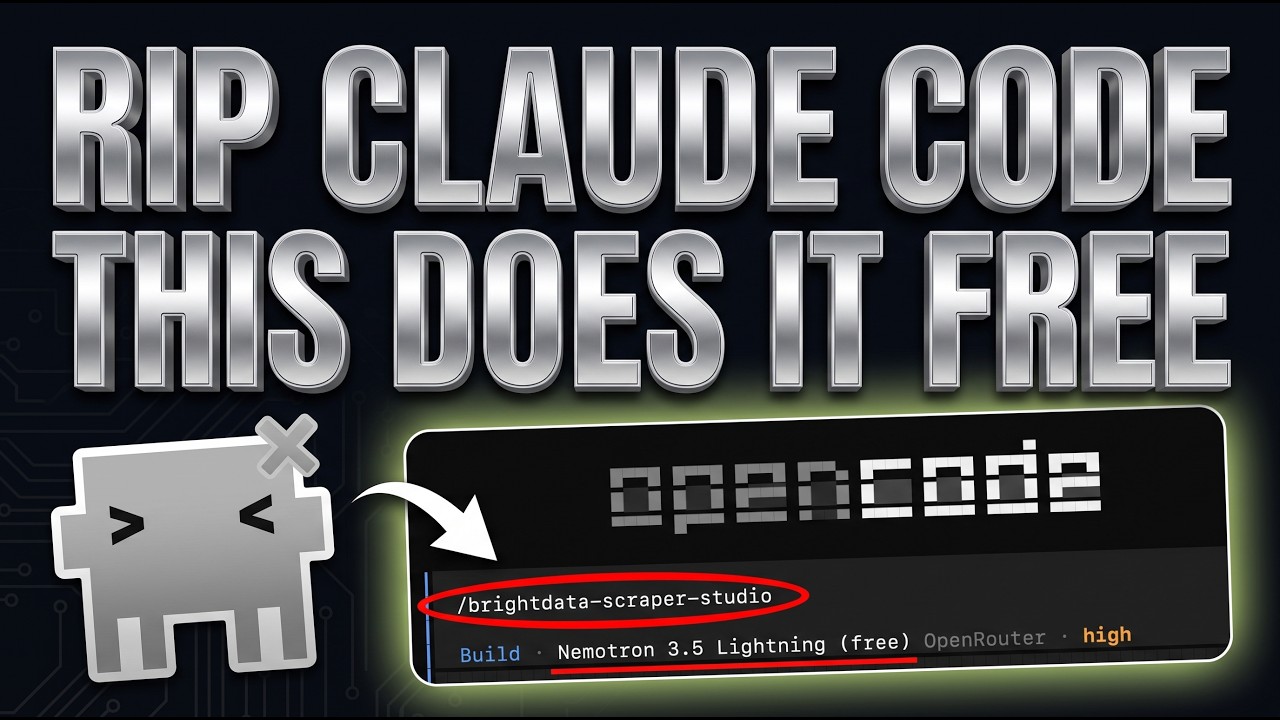
The useful part of this video is not the SEO task — it's the model-selection heuristic. OpenRouter's free tier lists dozens of models with no obvious way to tell which are worth using. The approach shown: filter output pricing down to free, then rank what's left by cumulative tokens used, on the reasoning that nobody burns hundreds of billions of tokens on a model that doesn't work. The run then uses OpenCode as the agent shell, with a skill installed from the terminal, to do a real analysis task at zero model cost.
"RIP Claude Code SEO: OpenCode + This MCP Does It 100% FREE" by Income Stream Surfers — Watch on YouTube →
The scraping component in this video uses a commercial service that sponsors the channel, and the video carries a referral offer. We've summarised the technique and deliberately omitted the promo code and referral framing — the model-selection and OpenCode parts stand on their own and work with any scraping tool you already have. Verify current free-tier terms yourself; free models on OpenRouter change often and frequently carry rate limits and data-retention conditions.
Key Takeaways
- The heuristic: usage volume as a quality proxy. On OpenRouter, go to Models, set output pricing to free, then look at cumulative tokens used. The reasoning given is straightforward — why would people burn tokens on a model for no reason? Sustained heavy use is a signal that a free model is actually worth running. In the video this surfaced a candidate at ~923 billion tokens over one at 81.2 billion.
- The model picked was Nemotron 3.5 Lightning (NVIDIA), chosen on that volume signal alone, and it gained roughly another billion tokens of usage during the recording — the metric moves fast enough to be worth re-checking.
- Match the model class to the task, not to the leaderboard. The explicit observation: this model may not be the best at coding, but a fairly simple task where it mostly looks for differences between two sets of structured data is well within reach. Free models are viable for comparison, extraction and diffing work even when they'd struggle to write your application.
- OpenCode is the free agent shell here. The whole stack — OpenCode plus a free OpenRouter model — carries no per-token cost, which is the stated point: this is how you'd work without the budget for a paid coding agent.
- Skills install from inside the terminal. The flow shown is a one-click copy of an install command, run in the terminal, then launching
opencodeand using/skillsto register it. Model selection is/models, and you can typefreein that picker to filter directly to the free tier. - Prefer the CLI over the GUI product when both exist. The prompt explicitly instructs the agent to use the vendor's CLI rather than its studio interface — agents generally do better against a command-line surface than a hosted UI.
- Scope the audit prompt to a gap analysis. The instruction pattern is: read the codebase to determine what we're trying to rank for, deep-dive the keywords, then find differences in metadata, HTML and JSON schema that competitors have and we don't. Framing it as "what do they have that we don't" gives the model a concrete, checkable target rather than an open-ended review.
- It found real gaps. The run correctly identified missing FAQ schema across the homepage, about page and several landing pages while noting one money page did have it, plus absent review/aggregate-rating and video schema. Worth noting for anyone auditing their own site: schema coverage is commonly inconsistent page-to-page rather than uniformly absent.
Commands & Code Mentioned
opencode          # launch the agent shell
/skills           # register an installed skill
/models           # open the model picker
free              # type in the model picker to filter to free-tier models
Caveats
- Usage volume is a popularity signal, not a benchmark. It filters out abandoned models; it does not tell you the model is good at your task. Treat it as a shortlist step, then test.
- Free OpenRouter models rotate, rate-limit, and can change terms without notice. Re-check before you build a routine on one — see our cost calculator and cost optimisation guide for the paid-tier comparison.
- The scraping half of this workflow is a paid service after its trial allowance. The zero-cost claim applies to the model, not to the whole stack.
More OpenClaw & Claude Code news
 Hyperframes Studio: draw on a frame, let your coding agent fix the video, and what it needs to run
 Google's Android skills for coding agents: the install commands, writing your own SKILL.md, and which new claims we could not confirm
 GitHub Copilot CLI agents: build one with /agent, share it through a plugin marketplace, then run it headless in CI
 Designing a CLI for agents, not humans: JSON in and out, one pattern, a skill that ships with it, and Airbyte's MCP lessons
 Anthropic cut 80% of Claude Code's system prompt: how to audit your own skills and CLAUDE.md with /doctor
 Why Reducto deleted its one-tool-per-endpoint MCP server and rebuilt it with fewer, workflow-shaped tools